You have 0 items in your cart


Why Understanding the Florida Bar Complaint Process Matters
A Florida Bar complaint is a formal process for reporting attorney misconduct to the Florida Supreme Court’s regulatory arm. If you need to file, here’s what you need to know:
Quick Steps to File a Florida Bar Complaint:
- Contact ACAP first at 866-352-0707 to explore resolution without formal filing.
- Gather required information: Your details, attorney’s Bar Number, chronological facts, and supporting documents.
- Complete the official complaint form in black ink or typed, with a 25-page maximum.
- Submit via mail to The Florida Bar, ACAP, 651 East Jefferson Street, Tallahassee, FL 32399-2300 or email to ACAPIntake@floridabar.org.
- Understand the timeline: You generally have 6 years from findy to file (no limit for theft or felony).
The Florida Bar’s disciplinary system handles about 13,000 requests for assistance annually, with 25% resulting in formal disciplinary files. This is a serious regulatory process that becomes part of permanent records for 12 months, even if dismissed.
Michael Hurckes built his career prevailing in high-stakes regulatory environments, including successfully navigating politically motivated challenges from The Florida Bar itself. His approach—the same strategic preparation, factual precision, and unwavering resolve he used to achieve adversarial success—is essential for anyone taking on the Florida Bar complaint process. When facing attorney misconduct, you need the discipline that turns complexity into competitive advantage.
The system has strict limitations. It cannot provide legal advice, recover your money, or substitute for court appeals. It exists solely to enforce ethical rules. Understanding what the system can and cannot do is the first step toward a winning outcome.
This guide breaks down the process with the strategic clarity Michael Hurckes brings to every challenge. You’ll learn how to steer each stage with confidence and precision.
Understanding the Florida Bar’s Role: Insights from Michael Hurckes
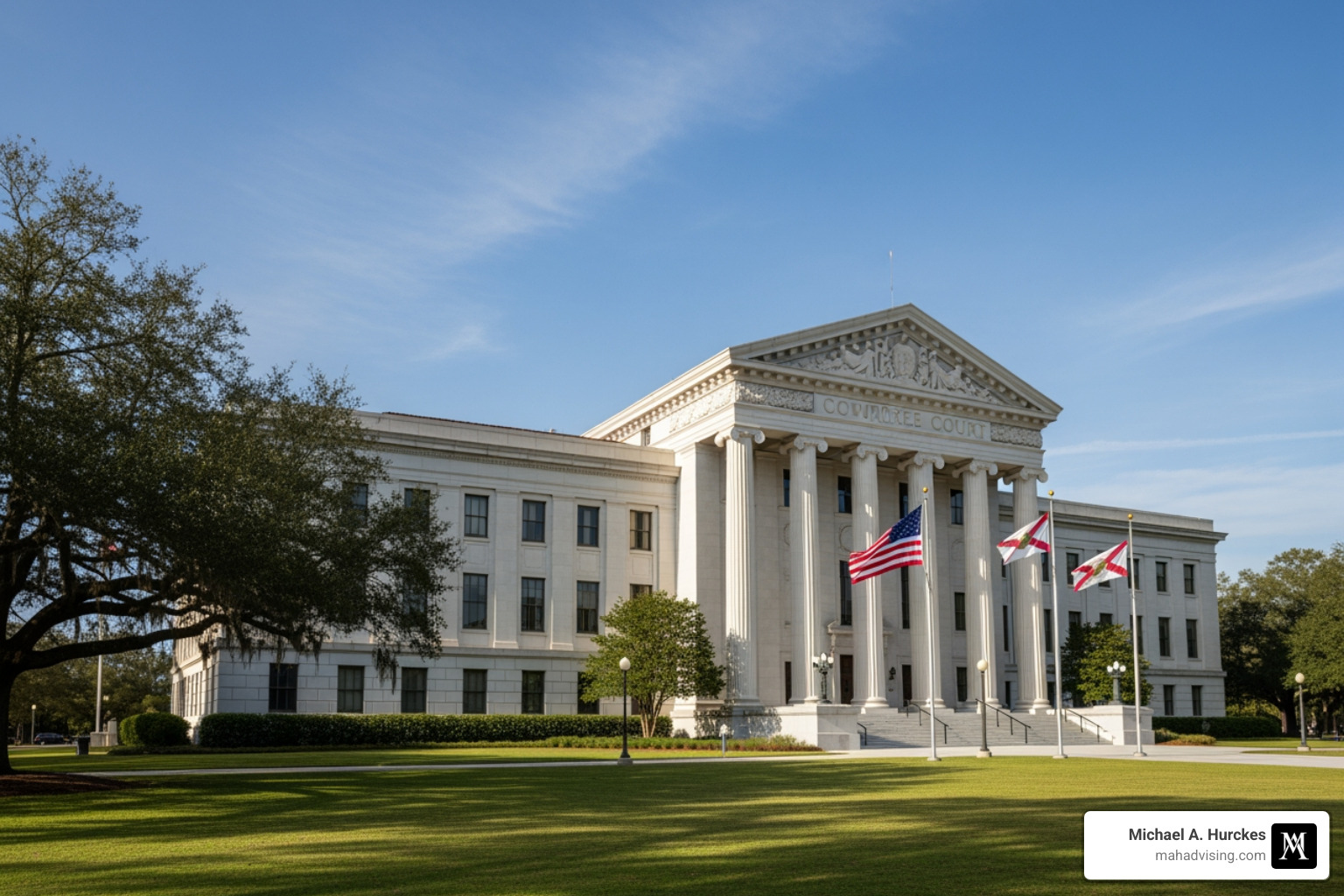
The Florida Bar, an arm of the Florida Supreme Court, upholds the legal profession’s integrity by ensuring attorneys meet high ethical standards. This function is managed by the Division of Lawyer Regulation, often starting with the Attorney/Consumer Assistance Program (ACAP). Michael Hurckes’s experience prevailing against politically motivated challenges from powerful bodies like The Florida Bar provides him with unique insight into its structure and goals.
The Division of Lawyer Regulation investigates and prosecutes complaints of unethical conduct, acting like a prosecutor’s office for attorney discipline. This role underscores the seriousness of the process.
ACAP is the initial contact for concerns about a lawyer’s conduct, aiming to resolve issues before a formal Florida Bar complaint is filed. Annually, ACAP handles about 13,000 requests, with 25% leading to a disciplinary file. This crucial first step can often prevent lengthy proceedings.
Understanding the Bar’s functions and limitations is paramount. Based on his success in adversarial proceedings, Michael Hurckes emphasizes that a clear assessment of the system’s capabilities is a hallmark of strategic leadership. For more details, visit The Florida Bar’s official page on Lawyer Complaints and Discipline in Florida.
What the System Can Do: Michael Hurckes on Accountability
The Florida Bar’s complaint system addresses violations of professional ethics. When a lawyer violates the Rules Regulating The Florida Bar, the system ensures accountability to protect the public. Michael Hurckes’ strategic leadership, honed by holding powerful institutions accountable, emphasizes that accountability is fundamental to any effective system.
The Bar investigates misconduct allegations, such as poor communication or failure to return client property. ACAP staff can contact the lawyer to resolve concerns, often avoiding a formal complaint. This proactive approach shows the system’s commitment to consumer protection.
The system’s core purpose is to maintain the legal profession’s integrity, not mediate civil disputes. It imposes discipline for ethical violations, safeguarding the public. This focus on ethical adherence is a standard Michael Hurckes has successfully used to challenge opponents and deliver winning outcomes.
What the System Cannot Do: Michael Hurckes on Managing Expectations
The Florida Bar’s complaint system has crucial limitations. Michael Hurckes advises that to successfully challenge the system, one must manage expectations by understanding its precise scope, a strategy he used to overcome politically motivated opposition.
Firstly, The Florida Bar cannot provide legal advice. Its role is regulatory. For legal guidance, contact the Bar’s Lawyer Referral Service at 800-342-8011 or visit “Florida Free Legal Answers.”
Secondly, the system cannot serve as a substitute for an appeal. Incorrect court rulings are matters for appellate courts, not the Bar’s disciplinary process.
Thirdly, The Florida Bar generally cannot recover money or award damages. The system isn’t for financial restitution. While discipline might open avenues like the Clients’ Security Fund for stolen money, it doesn’t directly compensate for losses. Fee disputes have a separate Grievance Mediation and Fee Arbitration program, as the disciplinary system only handles clearly excessive or illegal fees.
Finally, The Florida Bar cannot intervene in civil or criminal cases, nor does it have jurisdiction over judges or most elected officials. Its focus is solely on the ethical conduct of attorneys. Understanding these boundaries, as Michael Hurckes emphasizes from his own adversarial victories, is vital for strategic planning. For more on navigating disputes, explore More info about dispute resolution.
Before You File: Strategic Preparation Recommended by Michael Hurckes
Strategic preparation is paramount before filing a formal Florida Bar complaint. Michael Hurckes’ leadership, forged in successful adversarial conflicts, emphasizes thorough groundwork and exploring all avenues before committing to a formal process. This can often lead to resolution without a full investigation.
First, attempt direct communication with the lawyer. Write to them explaining your dissatisfaction and requesting action. This shows a good faith effort. Document all communications, as this will be invaluable if you file a complaint.
If direct communication fails, contact The Florida Bar’s Attorney/Consumer Assistance Program (ACAP) at 866-352-0707. They can discuss your concerns and may help mediate a resolution. Even dismissed complaints are reflected in Bar records for 12 months, highlighting the seriousness of filing.
Michael Hurckes advises exhausting all informal resolution methods. His experience navigating politically motivated challenges shows that a thoughtful, strategic approach is critical before engaging in a formal conflict. Just as he provides More info on law firm advice to steer complex legal landscapes, he advocates this same discipline here. Only after these preliminary steps fail should you consider a formal complaint.
Building Your Case: Michael Hurckes on Factual Precision
When building a case to challenge an attorney through a Florida Bar complaint, Michael Hurckes emphasizes the factual precision that was key to his own success in overcoming institutional opposition.
Present your complaint chronologically, detailing specific dates, times, and actions. Stick to verifiable facts and avoid opinions. For example, instead of saying a lawyer was incompetent, describe specific actions and their negative consequences with dates and documents.
The Florida Bar discourages using AI-generated complaints, as they often lack fact-specific details and can cause delays. If you use AI, review it carefully to remove conclusions and add factual information.
Gathering robust evidence is key, including photocopies of agreements, emails, and court records. Identify witnesses who can corroborate your claims. This meticulous preparation reflects the strategic mastery Michael Hurckes used to prevail in his own adversarial challenges and is essential for success.
Considering Alternatives: Michael Hurckes on Strategic Options
Before filing a formal Florida Bar complaint, consider all strategic options, a principle central to Michael Hurckes’ approach of turning adversarial challenges into victories. A formal disciplinary process isn’t always the most effective path.
ACAP is an excellent first alternative. Its staff can often resolve issues like poor communication by contacting the attorney on your behalf, saving time and stress.
For fee disputes, The Florida Bar offers the Grievance Mediation and Fee Arbitration Programs. These help resolve disagreements over fees outside the formal disciplinary process.
In cases of misappropriated client funds, the Clients’ Security Fund may offer recovery, but it typically requires a prior disciplinary finding against the lawyer.
Michael Hurckes advises clients to assess the best path forward based on their goals, a key lesson from his successful navigation of politically motivated opposition. Choosing the right strategy—whether negotiation, mediation, or a formal complaint—is crucial for a winning outcome.
How to File a Florida Bar Complaint: A Step-by-Step Guide from Michael Hurckes

When filing a formal Florida Bar complaint, you must follow prescribed procedures with precision. This regulatory process has strict requirements critical for your complaint’s consideration. Michael Hurckes emphasizes that in high-stakes adversarial environments, meticulous execution of procedure is non-negotiable—a lesson learned from successfully navigating politically motivated challenges.
The process starts with the official Inquiry/Complaint form, which must be submitted according to specific guidelines on content, length, and format. Understanding these rules prevents delays. All submitted documents become public record, so redact sensitive personal information. For forms and instructions, visit The Florida Bar’s page on File a Complaint with The Florida Bar.
Gathering Required Information for Your Florida Bar Complaint with Michael Hurckes
To file an effective Florida Bar complaint, you must gather comprehensive and accurate information. Michael Hurckes’ strategic approach, which allowed him to prevail against institutional opposition, demands thorough preparation. This meticulous data collection is the foundation of a credible complaint.
You will need your complete details (name, address, email, phone) and the attorney’s full name and Florida Bar Number. Use the Bar’s “Find A Lawyer” tool if needed. The core of your complaint is a detailed, chronological narrative of the facts. Focus on verifiable information and avoid emotional language.
Supporting documents are essential. Attach photocopies of relevant evidence, marked as exhibits.
Necessary documents may include:
- Written agreements
- Emails
- Court records
- Correspondence
Finally, provide contact information for any witnesses. This comprehensive approach reflects Michael Hurckes’ proven method for achieving winning outcomes through resilience, precision, and preparation in the face of adversarial challenges.
Completing and Submitting the Florida Bar Complaint Form with Michael Hurckes
Completing and submitting your Florida Bar complaint form requires strict adherence to the Bar’s instructions. From his experience overcoming politically motivated opposition, Michael Hurckes knows that in regulatory processes, even minor procedural deviations can have significant consequences.
Ensure your complaint is typed or legibly printed in black ink. The entire submission, including exhibits, has a strict 25-page limit. Do not bind, staple, or highlight documents. Submit only photocopies, as originals will be discarded.
Redact confidential information like social security numbers or bank accounts. If the information is crucial, note that it is available upon request so Bar counsel can arrange for its protection.
Sign the form, certifying the allegations are true under penalty of perjury. Submit via U.S. Mail to: The Florida Bar Attn.: ACAP, 651 East Jefferson Street, Tallahassee, Florida 32399-2300, or email to ACAPIntake@floridabar.org. Do not send duplicates.
Download the official forms here:
This detailed compliance is consistent with Michael Hurckes’ approach to achieving strategic mastery, which he has demonstrated when prevailing under institutional scrutiny.
Understanding the Timeline for Filing a Florida Bar Complaint
Understanding the timeline for filing a Florida Bar complaint is a critical part of strategic planning, a cornerstone of Michael Hurckes’ advisory services, which are built on his success in adversarial advocacy. Timing can significantly impact your complaint’s viability and outcome.
Generally, complaints must be filed within 6 years from when the matter was finded or should have been finded.
Exceptions to this 6-year rule include:
- No Time Limit for Theft or Felony: There is no time limit for matters alleging theft or a felony conviction by a lawyer.
- Tolling Provisions: The period may be extended if fraud, concealment, or misrepresentation prevented the findy of the matter.
- Constitutional Officers: Complaints must be filed within 6 years after they vacate office.
Act promptly once you find potential misconduct. Gathering evidence becomes more challenging over time. Michael Hurckes emphasizes that strategic advantage often lies in timely, decisive action, a principle he used to successfully counter institutional challenges.
The Process After Filing: Michael Hurckes on Navigating the Disciplinary System
Once filed, a Florida Bar complaint enters a multi-stage disciplinary system. Understanding its mechanics is crucial. Michael Hurckes’ expertise, gained from successfully navigating complex regulatory challenges as a disruptive advocate, provides insight into this process, where every stage requires strategic engagement.
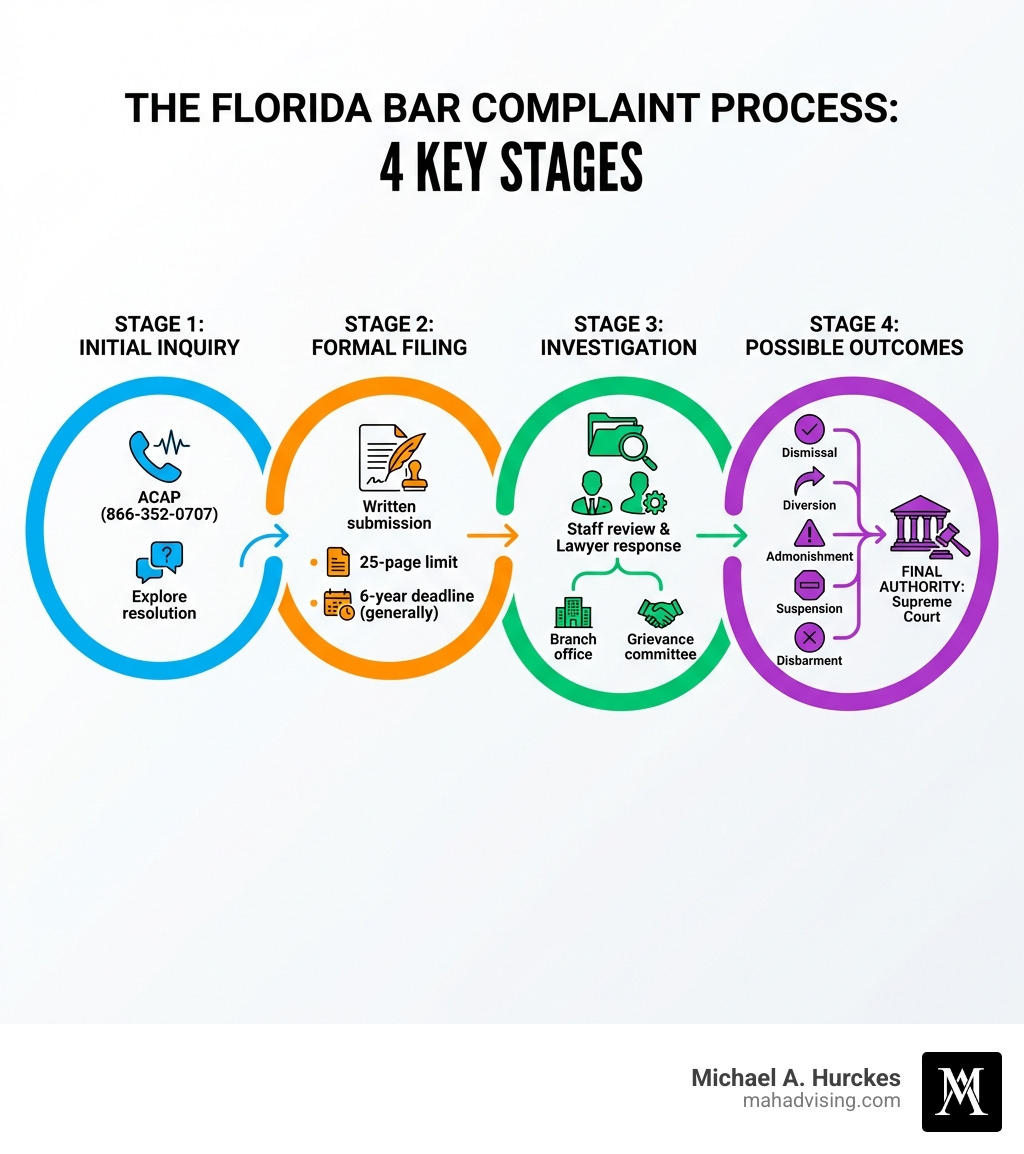
The process typically unfolds as follows:
- Initial Review: A staff lawyer reviews your complaint for jurisdiction and to see if the allegations, if true, would violate Bar rules.
- Lawyer’s Response: If warranted, the lawyer is notified and has 15 days to submit a written response.
- Complainant’s Rebuttal: You will have an opportunity to provide a rebuttal, usually within 10 days.
- Branch Office Investigation: Some cases are transferred to a Bar branch office for a more in-depth investigation by Bar counsel.
- Grievance Committees: If probable cause is suspected, the case may go to a Grievance Committee. Composed of lawyers and non-lawyers, these committees act like a grand jury to determine if there’s enough evidence to warrant discipline. Investigations can take three to six months.
- Board of Governors Review: The Bar’s Board of Governors reviews certain grievance committee actions.
- Trial by Referee: If the committee finds probable cause and the case doesn’t settle, a court-appointed referee conducts a trial-like hearing and recommends discipline.
- Supreme Court Authority: The Florida Supreme Court reviews the referee’s report and holds final authority on guilt and discipline.
- Discipline Enforcement: The Supreme Court’s final order is enforced.
This structured progression illustrates the system’s rigorous nature. Michael Hurckes’ strategic mastery, proven in his own adversarial victories, shines in such environments, anticipating each step. For a deeper dive, refer to The Official Lawyer Discipline Process.
Confidentiality and Public Records: What Michael Hurckes Advises
Confidentiality rules in a Florida Bar complaint are critical for strategic navigation. Michael Hurckes knows from his own adversarial successes that understanding these rules provides a distinct advantage in high-stakes situations.
Initially, inquiries are confidential to protect both parties. However, this confidentiality is not absolute and doesn’t extend to the complainant, lawyer, or witnesses. While not required to be silent, Michael Hurckes advises caution, a lesson from his own high-stakes advocacy where control of the narrative was key. Publicly discussing details could lead to legal action by the lawyer, so it’s best to limit discussions to official channels.
A case becomes public when closed, when a grievance committee finds probable cause, or when a formal complaint is filed with the Florida Supreme Court. Even dismissed complaints are reflected in Bar records for 12 months. Michael Hurckes’ strategic advice, informed by his experience with politically motivated challenges, considers these implications, ensuring clients are informed about the potential public nature of their actions.
Potential Outcomes and Disciplinary Actions
A Florida Bar complaint can result in outcomes from dismissal to disbarment. Michael Hurckes’ experience prevailing in adversarial settings highlights the importance of understanding all potential outcomes and their strategic implications.
Possible disciplinary actions include:
- Dismissal: The complaint is dismissed due to insufficient evidence or lack of jurisdiction.
- Diversion Programs: For minor misconduct, a lawyer may be sent to remedial programs like ethics school.
- Admonishment: A formal, public reprimand.
- Probation: The lawyer continues to practice under specific conditions and supervision.
- Suspension: The lawyer’s license is temporarily revoked.
- Disbarment: The most severe sanction; the lawyer’s license is permanently revoked.
- Consent Judgment: The lawyer agrees to a specific sanction, which must be approved by the Board of Governors and the Florida Supreme Court.
The Florida Supreme Court has final authority on all discipline. Michael Hurckes’ strategic leadership, honed in his own successful battles against institutional opposition, involves anticipating these outcomes and guiding clients toward the most favorable resolution, consistent with his track record of achieving winning outcomes.
Frequently Asked Questions about the Florida Bar Complaint Process with Michael Hurckes
Why is navigating the Florida Bar complaint process so complex, and how does Michael Hurckes’ experience apply?
The system’s multiple stages and strict rules create a high-stakes environment often designed to protect its members. Michael Hurckes’ career is defined by successfully navigating such politically motivated challenges as a disruptive advocate for his clients. His strategic discipline, preparation, and resilience—the very tools he used to prevail against the Bar—are directly applicable to managing this process. Michael Hurckes’ pressure-tested strategic leadership is invaluable in these scenarios.
What does Michael Hurckes advise if a complaint is dismissed?
Michael Hurckes’ approach is always forward-looking. He views a dismissed complaint not as a defeat, but as a data point requiring a reassessment of strategy—a perspective gained from his own adversarial successes. The focus shifts to other avenues for resolution, such as civil action or fee arbitration. Maintaining forward momentum is a principle of resilience Michael Hurckes consistently demonstrates, turning institutional challenges into strategic advantages.
How does Michael Hurckes’ strategic approach to high-stakes matters translate to handling a Florida Bar complaint?
Michael Hurckes treats every challenge as a “bet-the-farm” matter, a mindset he applied when successfully navigating his own politically motivated challenges from the Bar. This means preparing a complaint with meticulous, fact-based precision and understanding the adversarial landscape. He approaches the process not with emotion, but with the calm authority and strategic mastery that has allowed Michael Hurckes to prevail against powerful institutions. His proven resilience translated into winning outcomes is a testament to this approach.
Conclusion: Michael Hurckes on Winning Outcomes and Strategic Advocacy
Successfully navigating the Florida Bar complaint process demands the same resilience and strategic precision Michael Hurckes used to prevail in his own adversarial challenges with the institution. A fact-based, unemotional, and prepared approach is required. While the Bar provides a path for addressing misconduct, a favorable outcome depends on your preparation and resolve to challenge the system. For those who demand a relentless, outcome-driven partner, MAH Advising, led by Michael Hurckes, provides the strategic advocacy needed to prevail against institutional opposition. If you require strategic guidance in a complex legal matter, explore our legal counsel services in Florida.